Showing posts with label Burnelli. Show all posts

Tuesday, December 20, 2011

Burnelli, the Story

Why do car manufacturers go to great lengths to build a roll-cage around passenger compartments but aircraft manufacturers build aircraft with as little as 13% of the aircraft structural weight to protect passengers?


Thank you Larry Pope!
The Burnelli Story
Below are excerpts from this great site...check it out!
Burnelli Story via Vimeo courtesy of Ralph Capobianco

In November 1999, Fox News 29 in West Palm Beach, Florida did a “Fox Files Report” on Burnelli and interviewed our late Chairman and President, Chalmers H. Goodlin. For those of you who have not seen it, we believe it is an excellent 5 minute introduction to the topic.
Already 10 years has passed and, as far as we know, this is the only TV report done about Burnelli during that time. How do we get more coverage about this safer, more efficient design in the media?  Would you like to see more reports in the news? Write a letter to the editor, write / email your local TV station and ask them to expose Burnelli to others in your area.


Cars are designed with crashworthiness in mind. Portions of the car will deform to absorb the energy of a crash and the portion of the car where the passengers are is designed to stay intact.  Airplanes are not.  When you see pictures of a plane crash, you often see only a tail, the wheels, maybe an engine or two but the structure that is supposed to protect the passengers is missing, having disintegrated during the crash – it did not protect the passengers.
The position maintained by officialdom, that most accidents are caused by pilot error, may be correct, but it ignores the more fundamental and important question which asks:
“what are most fatalities due to?”
There is ample evidence that:
“most fatalities are caused by the irresponsible common practice of hanging engines and landing gear onto fuel tank supporting structure in combination with excessively high take-off and landing speeds on overstressed tires.“
And when the question regarding the cause of most fatalities is answered, the next question becomes:
“Why do we continue to build and fly aircraft that have such low survivability rates in case of crash, when an alternative exists and has existed for over eight decades?”


Since the 1940s an aircraft design exists that makes aviation crashes more survivable – a Burnelli.
In its December 1946 issue, Mechanix Illustrated, in an article entitled “Something New on the Wing” stated:
“In addition to their hitherto unapproached stability, 80 passenger ships of the new 1946 design, … are designed to descend on the water with complete safety and travel for days under their own power as full-fledged sea-going boats. This feat is the more remarkable in consideration of the fact that they are strictly land planes.
Under any circumstances necessitating a landing at sea, passengers of this type of ultra modern sky hotel lose none of the comfort and luxury that they enjoyed in the air. A specially designed mechanism, which cannot be operated in flight, is used to disengage the wings from the fuselage section once the ship is on the water. Once this is done, even a stormy sea holds no terrors for the occupants of the safety-sealed fuselage with its complete set of navigation instruments and its diesel-driven underwater propeller. In short, a landing at sea is not even an emergency for this newest of passenger aircraft.”


A hopeful message from the New England Air Museum yesterday. “Upon completion of the multi-year restoration of our Douglas A-26 Invader, anticipated for mid-2012, the Burnelli CBY will be moved into our restoration facility for its restoration.” 
Michael P. Speciale, NEAM.
After so many years in the New England winters, the CBY-3 will finally 
be recognized for the historic, aviation gem that it is.  

Tuesday, July 26, 2011

Burnelli Safe Flying-Wing

I just had to post this after seeing Captain America, the plane that Red Skull tried to escape in was very similar to the Burnelli flying wing design.


Sunday, March 6, 2011

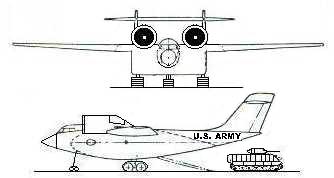
Burnelli BG-177

Goodbye Future Transport Rotorcraft, 
Hello Army Future Maneuver Aircraft?


"The ideal troop-carrier combat transport would appear to be a large transport of the twin-boom type for which personnel, artillery, and vehicles could be dropped. It should have a range of two thousand miles and should be equipped with self-sealing tanks, pilot armor, and a retractable track-laying undercarriage. This last feature would permit its landing and take-off in pastures and cultivated areas. It would thus be able to enter the airhead early in an operation, landing and taking off from areas normally suitable only for gliders".

--General James M. Gavin, Airborne Warfare, 1947

The U.S. Army has recently declared that its Future Transport Rotorcraft (FTR) is shelved indefinitely due to a lack of money since most funds are going instead towards buying vulnerable and inferior LAV-III/IAVs and developing the Future Combat System (FCS) rubber-tired armored car command post-on-wheels bombard & occupy fantasy. Fortunately, this may be a blessing in disguise for the U.S. Army.
Combined with the inefficiency of feeding passengers from small airports by small prop planes into large airports to fly in larger jumbo jets is the lack of security such an out-of-control situation creates made apparent by the 9/11 suicide airliner terror attacks and the infuriating lack of safety when people surrounded by fuel tanks crash in these jets. The American public is fed up with the airline industry status quo and its lies and excuses using relativity statistics to say "everything is a.o.k". Nobody wants to die in a fiery aircraft crash nor wait in line for hours to make a trip that direct-delivery in their personal ground automobile would almost get them there sooner. The time/speed advantages of air travel over ground travel are being "red-taped" away during the prop plane hops to the major airport hub and the long security check lines.

However, right now AirBUS with their 600-passenger deathtrap A380 is killing the American commercial airline industry (re: Boeing). Boeing led by wimps have given up on faster airliners like the Sonic Cruiser in favor of yet another "fuel miserly" and unsafe tube and wing airliner. We are going to lose our shirt to AirBUS who at least have a VISION of passenger comfort (until they crash & burn). Boeing isn't offering a vision. Let us offer one then. ITS AIRLINE SAFETY, STUPID.
After the 9/11 terror attacks that used airliners as suicide planes, Americans today have an all-time low trust in air travel---and rightly so---its not just terrorist acts, either---its the needless and insufferable aircraft crashes, caused by unimaginative aircraft designs best depicted in the film, "Fearless" and smug, cavalier attitudes by the air travel and aircraft manufacturer industry. Why doesn't America transfer unsafe, unused jet airliners to DoD to solve U.S. military airlift and strategic mobility problems???

Its time we solve the public's lack of confidence in air travel or there will not be an "aviation industry" to save.

With Burnelli ESTOL jet transports we will no longer have to endure the endless series of flaming aircraft crashes leaving burnt pieces of human beings all over our cable fed TV screens, as air travel is decongested reducing the fatigue and confusion that causes aircraft engine and airframe failures, collisions, human errors that result in fatal crashes.


Another bad reality is that when you land high-ground pressure rubber tired aircraft onto dirt assault zones, they rut the surface. As shown above from the southern Afghan airbase, engineers will have to constantly resurface the runways, taking time and effort. Refer to the report at the bottom of this page. So while wheeled aircraft can land onto dirt assault zones, it would be much better if they had TRACKED or ideally air cushion landing systems so the surface condition of the area will not be a limiting factor.

The Vincent Burnelli lifting body design could be applied to a seaplane....British designer H. Roxbee Cox proposed this 6-engined flying wing seaplane just before WWII...with an unlimited take-off run and the 100% lift efficiency of a flying wing, the SEAPLANE deserves another examination with modern technologies....


lso imagine if a Burnelli-type Extremely Short Take-Off and Landing (ESTOL) aircraft had
air cushion landing gear?
Concept courtesy of Mr. Ernest Zavala who is writing a book on the history of Burnelli aircraft...


Imagine setting up our troops anywhere around the world in less than 12 hours after leaving their U.S. home base and deploying them to surround the enemy in all terrain? Ride on a cushion of air and set them down without having to "daisy" bomb an area for landing an aircraft. Talk about them not knowing where we will strike!
Conclusion: Army can afford a New Future Aircraft for Decisive Maneuver if its got civil applications


For the full story see Goodbye FTR, Hello AFMA

Sunday, February 20, 2011

Burnelli or Northrop Flying Wing

Artistic drawing of Northrop B-49


Northrop B-49 and a contemporary Burnelli clearly reveal the distinction between the 2 approaches to the flying wing. Burnelli concentrates 60% of the structural weight around the passenger cabin to which is attached the landing gear and engines, the fuel tanks being isolated in the outer wings.


 Because of longer load paths, Northrop distributes the structure throughout the span and places the passengers, engines and fuel tanks all virtually in the same container, the landing gear being attached to fuel tank supporting structure. When the Burnelli UB-14 crashed, the fuselage remained intact; there was no fire and the crew survived without injury. In the Northrop B-49 crash, the entire airplane broke into fragments and 5 crew were killed. There is little change in the payload weight capability of the two designs, but when examined from the standpoint of floor area and internal volume, the difference is enormous. Because of this, Burnelli design lends itself to both military and commercial applications without restrictions, but Northrop could only be viable for specific military use.


USAF reports said the B-49 was extremely unreliable and very difficult to fly on a bombing mission because of continual yawing and pitching caused by control arrangements.


"The maximum trimmed lift coefficient of 1.31 for the twin boom airplane and 1.03 for the all-wing plane gave stalling speeds at sea level of 82 and 92 mph respectively. The investigation indicated both planes will have essentially the same performance in range and climb rate, but reduction in drag for the twin-boom plane at high-lift coefficients represented increased performance over the all-wing plane in take-off. The elevator of the twin-boom plane ranged from -0.0055 to -0.0072 per degree for all conditions tested and was about twice that of the all wing configuration. The twin-boom plane will have about a 7% shorter take-off run and requires about 9% less distance to clear a 50ft obstacle than the all-wing plane. If both planes are designed to meet the same stall speed, the total wing area required will be reduced over 20%, or 1/5th, thereby permitting the outboard wing panels to be of reduced chord and thickness, with corresponding reduction of drag and weight of wing structure. Also, flaps of higher lift qualities can be employed on the air-foil body and wings with the twin boom design because of the greater longitudinal stability and control."


Finally, the fact that Northrop misappropriated Burnelli's 1940s technology in constructing the B-2 again shows that Burnelli was always right and proves that the Northrop flying wing was wrong.


Probably the most glowing Wright-Field report on an airplane design by U.S. Army Air Corps - U.S.A.F. was reflected in General Arnold's September 19, 1939 letter to Secretary of War.
----start of General Arnold's letter to Secretary of War Woodring---
September 19, 1939
The basic principle of the lifting fuselage as developed by V. J. Burnelli since 1919 is now in such an advanced stage that it is extremely important for the Air Corps to experiment further with it with a view to reducing it to military practice.
From studies of the research made by the Burnelli Co., the NACA and the Air Corps the military adaptability of the basic design has the following advantage over the orthodox streamlined deadweight fuselage.


  1. The coefficient of drag is the lowest known for any useful airplane today.
  2. The coefficient of lift is greater.
  3. The lifting fuselage has distinct advantages for the installation of power plants, bombs, armament and all other accessories over the streamlined fuselage.
  4. From wind tunnel tests already conducted by the NACA and NYU the performance is exceptionally' good in every phase.
  5. The design embodies extremely good factors of safety--considerably higher than the streamlined fuselage type.
  6. The design is simple of construction and in the opinion of the Air Corps lends itself to high speed production better than any design and therefore the valuable time element involved in all production contracts can be taken advantage of to its fullest extent.
  7. It is apparently a cheaper airplane to build because of the time element referred to in 6 above.
It is to be remembered that Mr. Burnelli was the first to reduce to practice the use of smooth skin surface on airplanes in cooperation with the Material Division under Maj. Carl Green's supervision.
We understand that the present company has no affiliation with the British Company manufacturing under the Burnelli patents. We are informed by the company that the British have built one commercial article under the designs of a ship built by Mr. Burnelli in 1929, and that this design only resembles the designs submitted to the Air Corps in basic principles. We also understand that this airplane was tested at Farnsborough by the RFC with excellent results, substantiated by a cable from the British manufacturer, a copy of which we have.
We have also seen articles in various British technical magazines that are extremely flattering to the basic design involved and the report of the test pilot, Mr. Clyde Pangborn, would indicate that the design embodies extremely good flying qualities under all conditions of a very severe flight test required by the RFC.
It is, therefore, the opinion of the Air Corps that this project should be carried through to its fullest experimental possibilities and probably to the ultimate conclusion for the purchase of a prototype.
I am informed by the Burnelli Company that in an effort to cooperate with the Air Corps they have proceeded with the required work and at this moment it is seventy percent completed.
In my opinion it is essential, in the interest of the national defense, that this procurement be authorized.
----end of General Arnold's letter to
Secretary of War Woodring---


"The Committee recommends that the Air Corps inform both the Central Aircraft Corporation and V.J. Burnelli Airplanes, Inc., and any other concern which may later possible become interested in the Burnelli 'lifting fuselage', that this design is of no interest to the Air Corps and that for this reason, no further correspondence, consultations, or reviewing of data embodying this design will ever again be considered by the Air Corps or the Materiel Division."